
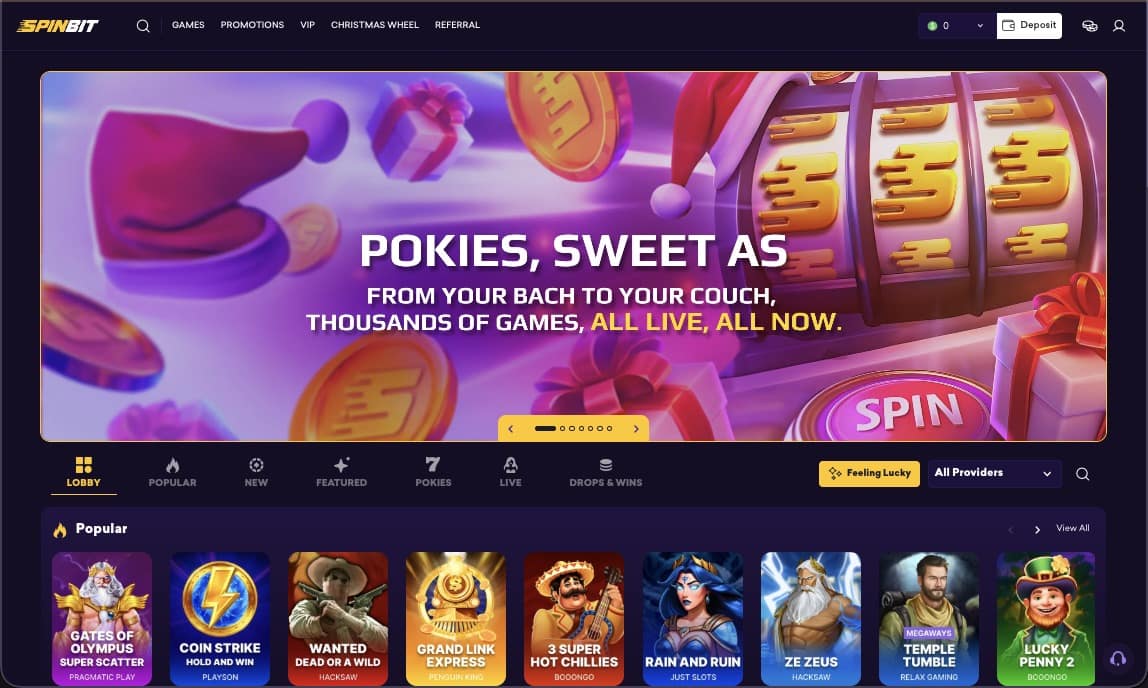
For the discerning New Zealand online gambler, a platform’s technical infrastructure is as crucial as its game library. This whitepaper provides an exhaustive operational and security analysis of Spinbit nz, a casino brand that has garnered attention in the local market. Moving beyond superficial review, we will dissect the mechanics of its bonus systems, validate its security claims, and map its financial transaction protocols. Our objective is to furnish you with the data needed to make an informed, technical assessment of this platform’s reliability and value proposition.
Before You Start: Technical Prerequisites Checklist
Prior to engagement, ensure your system and understanding meet these baseline requirements for optimal operation and compliance.
- Geolocation Verification: Confirm you are physically located within New Zealand. Spinbit’s license (Curaçao eGaming) mandates strict geo-blocking. VPN usage is prohibited and will trigger account closure and forfeiture of funds.
- Documentation Readiness: Have digital copies (JPG/PDF) of a government-issued photo ID (passport, driver’s license) and a recent utility bill or bank statement (less than 3 months old) for KYC verification. This is non-negotiable for withdrawals.
- Device & Browser Compliance: The platform uses HTML5. Ensure your browser (Chrome, Firefox, Safari) is updated. For app users, download only from the official Spinbit1.co.nz website to avoid malicious APK/IPA files.
- Payment Method Alignment: Decide on your primary deposit/withdrawal channel. Analyze limits and fees: Intermediary banks may charge for NZD-to-EUR conversions if using international payment processors.
- Bonus T&Cs Acumen: Mentally prepare to calculate wagering. This is a mathematical exercise, not just a promotional claim.
The Registration Protocol: A Step-by-Step Systems Analysis
Registration is the first handshake between your data and Spinbit’s servers. The process is standard but contains critical technical checkpoints.
- Data Packet Submission: Navigate to the site and click ‘Sign Up’. You will submit a data packet containing: email, currency (NZD), password, and personal details (name, DoB, address). Accuracy is paramount; mismatches with subsequent KYC documents will cause significant verification delays.
- Account Authentication: Verify your email via a unique, time-limited link sent to your inbox. This confirms control of the email protocol and activates your account’s base-level permissions.
- Initial System Interaction: Log in. Before depositing, navigate to the cashier and bonus sections. This is not to claim, but to audit. Read the full bonus Terms & Conditions and payment method lists. This is your pre-flight systems check.
- First Deposit & Data Binding: Choosing a deposit method creates a binding link between your casino account and your financial instrument. This link is heavily scrutinized during KYC. Using a method in another person’s name will result in permanent failure of the verification routine.
Bonus Mathematics: Calculating the True Cost of « Free » Credits
Promotional offers are financial instruments with contractual obligations. We will model a common welcome bonus scenario at Spinbit Casino.
Scenario: 100% deposit match up to NZ$500 + 200 Free Spins. Wagering Requirement (WR): 40x the bonus amount. Game Weighting: Slots contribute 100%; table games contribute 5%.
Assumptions: Player deposits NZ$500, receives NZ$500 bonus + 200 spins (valued at NZ$0.10 per spin = NZ$20 potential winnings). Total bonus credit: NZ$520. WR = 40 x NZ$520 = NZ$20,800.
Mathematical Execution:
- Optimal Play (Slots Only): You must wager NZ$20,800 on slots. With a typical average RTP of 96%, the expected loss through wagering is 4% of the total turnover. Expected Loss = NZ$20,800 * 0.04 = NZ$832.
- Cost of Bonus: You received NZ$520. Expected cost to release it is NZ$832. This is a negative expected value (-EV) proposition under these conditions. The bonus only becomes potentially +EV if the wagering can be completed on games with a higher-than-average RTP or through strategic use of free spin winnings.
- Table Game Pitfall: If you play blackjack (5% contribution), your NZ$100 wager only clears NZ$5 of the WR. To clear the full NZ$20,800 WR, you would need to wager NZ$416,000, magnifying the expected loss exponentially.
Conclusion: The bonus is a high-volatility contract. Its value is not in the credit amount but in the combination of WR, game weighting, and game-specific RTP. Always calculate the Expected Cost (WR * House Edge) before commitment.
| System Component | Specification / Protocol | Technical Note |
|---|---|---|
| Licensing Authority | Curaçao eGaming (Master License 365/JAZ) | Standard international license. Enforcement relies on the operator’s adherence. Verify active status via Curaçao registry. |
| Encryption Standard | SSL/TLS 1.2+ (256-bit) | Industry standard for data-in-transit encryption. Verify by checking for the padlock icon and HTTPS in the address bar. |
| Random Number Generator (RNG) | Certified by iTech Labs | Third-party auditing for fairness and unpredictability. Certification IDs should be publicly accessible in the footer. |
| Core Game Providers | NetEnt, Pragmatic Play, Play’n GO, Evolution | Top-tier providers with independently audited RTPs. Ranges from 94% to 99+% depending on game type. |
| Standard Withdrawal Time | 1-3 Banking Days (post-KYC) | Processing time excludes weekends/bank holidays. E-wallets (Skrill, Neteller) are typically fastest (<24h). |
| Monthly Withdrawal Limit | Typically NZ$50,000 | A hard cap on cash-out velocity. High rollers must plan withdrawals across cycles. |
Banking Systems: Transaction Protocols and Network Latency
Spinbit NZ’s payment ecosystem is a gateway between NZD and various digital and traditional finance networks.
- Deposit Network (Near-Instant): Transactions are credit pushes. Funds move from your bank/e-wallet to the casino’s merchant account. Approval is automated, relying on pre-authorization and fraud scoring. Methods include Visa/Mastercard, POLi, Skrill, Neteller, and direct bank transfer. POLi is a NZ-specific system offering direct online banking access without card details.
- Withdrawal Network (Batch Processing): Transactions are credit pulls. This is a manual or semi-automated process involving security reviews. The protocol: 1) Request submitted. 2) Internal audit (bonus compliance, playthrough). 3) KYC document verification. 4) Approval and queuing for batch processing by the finance department. 5) Dispatch to payment processor. 6) Final crediting by your bank/e-wallet. Each step introduces potential latency.
- Currency Network Fee Analysis: While Spinbit may not charge fees, network intermediaries often do. If depositing NZD to a processor that settles in EUR (like many international e-wallets), your bank applies a forex spread (2-3%). For a NZ$1000 deposit, this could be a NZ$20-30 implicit fee.
Security Architecture and Fair Play Auditing
Security is multi-layered. We examine the key pillars supporting Spinbit Casino’s operational integrity.
- Data Layer Security (Encryption): All sensitive data (login, personal, financial) is encrypted using TLS 1.2 or higher during transmission. At rest, data should be encrypted using AES-256 standards. This protects against man-in-the-middle attacks and data breaches.
- Certified RNG & Game Fairness: The iTech Labs certification is critical. It means the RNG’s algorithm and output have been tested for statistical randomness, ensuring no predictable patterns. Game RTP percentages are derived from these certified RNGs and are published per game by the providers.
- Operational Security (KYC/AML): The mandatory verification process is an Anti-Money Laundering (AML) control. It links your digital identity to a legal one, preventing fraud, multi-accounting, and financial crime. This protects the ecosystem’s integrity for all users.
- Responsible Gambling Protocol: Technical tools include deposit limits, loss limits, wager limits, session time reminders, and self-exclusion. These are systemic circuit breakers you can configure in your account settings. Their effectiveness depends on your adherence to the parameters you set.
Advanced Troubleshooting Scenarios and Resolutions
When system interaction fails, a logical diagnostic approach is required.
Scenario 1: Login Failure (« Invalid Credentials »)
Diagnosis: This is an authentication error. Probable causes: (A) Incorrect username/password, (B) Account locked due to excessive failed attempts, (C) Browser cache/cookie corruption, (D) Account temporarily suspended by security.
Resolution Path: 1) Use ‘Forgot Password’ to reset. 2) Clear browser cache and cookies or try a different browser/incognito mode. 3) If unresolved, contact support from your registered email, providing your username. Do not claim to be locked out from your account in the live chat without verifying your identity first.
Scenario 2: Withdrawal Pending Beyond 72 Hours
Diagnosis: The transaction is stuck in the internal audit or KYC queue.
Resolution Path: 1) Check your email (including spam) for a verification request from the finance team. 2) If no email, contact support and ask, specifically, « Can you confirm if my withdrawal is pending KYC verification or internal audit? » This precise question escalates your query to the correct department faster than a generic « Where is my money? »
Scenario 3: Game Malfunction (« Game Round Not Settled »)
Diagnosis: A client-server desynchronization or a game logic error.
Resolution Path: 1) Do not refresh repeatedly. Take a screenshot of the game ID and round ID (visible in game history). 2) Close and reopen the game. 3) If balance is incorrect, contact support immediately, providing the screenshot and details. All game rounds are logged on the game provider’s server; support can request a manual audit of the round outcome.
Extended FAQ: Technical and Operational Queries
Q1: Is Spinbit Casino NZ legally licensed to operate for New Zealand players?
A: Yes. It operates under a sub-license from Curaçao eGaming (Master License 365/JAZ). This license permits it to offer services internationally, including to New Zealand, where the legal onus is on the player to ensure they are of legal age and that using such services does not contravene local regulations.
Q2: How are the Return to Player (RTP) percentages enforced and verified?
A: RTP is a long-term statistical average calculated over millions of game rounds. It is hard-coded into the game’s mathematics by the provider (e.g., NetEnt, Pragmatic Play). Independent auditors like iTech Labs and eCOGRA verify that the game’s source code produces outcomes consistent with its published RTP. Spinbit does not control or alter this value.
Q3: What is the precise data flow during a POLi deposit?
A: 1) You select POLi at Spinbit’s cashier. 2) You are redirected to a POLi page to select your bank. 3) You are redirected to your bank’s secure login portal (hosted by your bank). 4) After authenticating, you authorize the payment. 5) POLi sends a confirmation to Spinbit. Your banking credentials are never shared with Spinbit; they remain between you, POLi, and your bank.
Q4: Can I use a strategy or betting system to overcome the house edge on live dealer games?
A: No fundamental strategy can alter the mathematical house edge built into a game’s rules. Card counting in live blackjack is ineffective due to continuous shuffling machines (CSMs) and frequent deck penetration changes. Betting systems like Martingale affect bankroll management, not the odds, and risk hitting table limits or depleting your balance during a losing streak.
Q5: What happens to my bonus if I request a withdrawal before meeting wagering?
A: This triggers the ‘Bonus Cancellation’ clause in the T&Cs. The entire bonus amount (and any winnings generated from it) will be forfeited from your balance. Your original deposit amount may remain withdrawable, subject to standard processing.
Q6: How does the « Provably Fair » system work for selected games?
A: Provably Fair uses cryptographic hashes (like SHA-256). Before your bet, the server generates a random result and a secret seed, creating a hash. You are given this hash. After you bet, the server reveals the secret seed and the result. You can use a calculator to combine the seed and result to reproduce the hash. If it matches, the game was fair and the result was determined before your bet.
Q7: Why was my document verification rejected?
A: Common technical reasons: (1) Blurry or cropped image where edges/corners are missing. (2) Glare on holographic elements. (3) Mismatch between the name/address on your ID and the utility bill. (4) Document is expired. (5) Screenshot instead of a photo/scan. Always submit clear, full-document, color images in JPG or PDF format.
Q8: Are there any systemic advantages to using the downloadable app vs. the browser?
A: The app is a wrapped browser (WebView) offering potentially faster load times for cached assets and push notifications for promotions. It does not provide access to different games or better odds. Security is identical, as all critical operations (RNG, transactions) occur on remote servers, not locally on your device.
Q9: What is the protocol for a disputed game outcome?
A: The official chain of custody for dispute resolution is: 1) Player submits claim to Spinbit support with evidence (screenshot, game ID, time). 2) Spinbit’s game operations team reviews their logs. 3) If unresolved, Spinbit escalates the query to the game provider (e.g., Pragmatic Play). The provider’s server logs are the final arbiter, as they independently record every game event. This process can take 5-10 business days.
Q10: How are winnings from no-deposit free spins typically handled?
A: Winnings from no-deposit free spins are almost always issued as « bonus money » with a high wagering requirement (e.g., 50x-70x). There is also usually a maximum cashout limit (e.g., 5x the spin value). This limits the platform’s liability from promotional giveaways while still offering a potential path to real money.
Conclusion: A Platform of Standardized Technical Execution
The technical audit of Spinbit NZ reveals a platform operating on industry-standard protocols. Its strengths lie in a reputable game provider roster, standard SSL encryption, and certified RNGs, forming a reliable core gaming environment. The critical variables for the user are the high-volatility nature of its bonus contracts and the imperative for flawless KYC documentation to ensure smooth financial transactions. There are no glaring systemic red flags, nor exceptional technological innovations. It is a competent operator within the established framework of internationally licensed online casinos. The informed user, equipped with the mathematical and procedural knowledge contained in this whitepaper, can therefore engage with Spinbit Casino from a position of calculated understanding, optimizing for entertainment value while mitigating procedural friction.